Most vehicles breaking down on the shoulder of Route 1 or the Trans-Canada near Moncton today are AWD or 4x4. Crossovers, SUVs, pickup trucks — the majority of passenger vehicles sold in Atlantic Canada over the past decade are no longer rear-wheel-drive. That shift matters when it comes time to call a tow truck, because equipment that worked fine for a 1990s rear-drive sedan can cause real drivetrain damage to a modern AWD vehicle. Here's what to know — and what to ask for — before the truck arrives.
Why a wheel-lift isn't the right tool
A wheel-lift tow picks up two wheels — usually the drive wheels — and lets the other two roll on the pavement. On a rear-wheel-drive vehicle, lifting the rear and letting the front roll is fine: there's no mechanical connection being stressed. The front axle spins freely.
On an AWD vehicle, every axle is mechanically linked. When the rear wheels are in the air and the front wheels are rolling down the highway at 80 km/h, the drivetrain is being driven from the front while the rear driveshaft hangs in suspension. That rotation — transmitted through the transfer case, differentials, and axle shafts — can damage components that weren't designed to operate that way. The same problem runs in reverse: lift the front and let the rear roll.
The fix is simple: all four wheels off the ground. That means a flat-deck carrier, where your vehicle rides on the deck. Nothing rolls. Nothing spins.
How the drivetrain works — and why it matters
An AWD system ties the front and rear axles together through a transfer case and, in most vehicles, one or more differentials. The purpose is grip — power goes to whichever wheel needs it. But that mechanical connection between front and rear is exactly what makes a partial lift dangerous.
A 4x4 system works similarly. In 4x4 mode, front and rear axles are locked together. Even in 2WD mode on a part-time 4x4, many transfer cases don't allow the front or rear driveshaft to spin freely. You'd need to check the owner's manual — and frankly, so does the driver who doesn't know the exact spec of your truck.
The damage isn't always immediate or obvious. Towing AWD vehicles on a wheel-lift for short distances at low speeds has been done without incident. But at highway speeds over a real distance, the risk of transfer case failure or differential damage climbs significantly. Repairs to these components regularly run into the thousands of dollars.
Which vehicles need a flat deck
If you're not sure whether your vehicle is AWD or 4x4, look for a few clues:
- Badges and badging. AWD, 4x4, 4WD, SH-AWD, xDrive, Quattro, e-AWD — these are all manufacturer names for systems that link all four wheels.
- The owner's manual. Check the towing or roadside section. Most specify whether a flat deck is required and whether there's a safe towing mode.
- Common AWD vehicles in NB. Subaru Outback and Forester (permanent AWD), Toyota RAV4 and Highlander AWD, Honda CR-V AWD, Ford Explorer and F-150 with 4x4, Jeep Grand Cherokee, Dodge RAM 4x4 — if your vehicle is any of these, assume a flat deck unless you know your specific drivetrain spec.
Rear-wheel-drive and front-wheel-drive vehicles don't have this issue and can be safely wheel-lifted or dollied.
Can't you just put it in neutral?
Sometimes — but it depends on the vehicle. Some full-time AWD systems have no neutral setting at all. Some 4x4 trucks have a transfer case neutral, but the procedure matters: it has to be engaged correctly, at low speed, and you'd need to confirm with your owner's manual that free-rolling in that position doesn't stress another component.
The safest answer — and the answer any reputable towing company will give you — is: don't guess. If you're not certain your specific vehicle can be safely wheel-lifted, request a flat deck. The cost difference between a wheel-lift and a flat-deck tow is real but manageable; the cost of a transfer case or differential rebuild is not.
What to tell the dispatcher
When you call, lead with two things: your vehicle's year, make, and model, and whether it's AWD, 4x4, or 4WD. That's enough for a dispatcher to confirm the right equipment. Don't wait for them to ask — they're coordinating multiple calls, and giving them that information upfront gets the right truck rolling faster.
If you're not certain about your drivetrain, say so. "I think it's AWD but I'm not sure" is a useful answer. The driver will know what to look for when they arrive.
For more on how towing rates are calculated — including what flat-deck versus wheel-lift work typically costs — read our New Brunswick towing cost guide.
Who you're calling
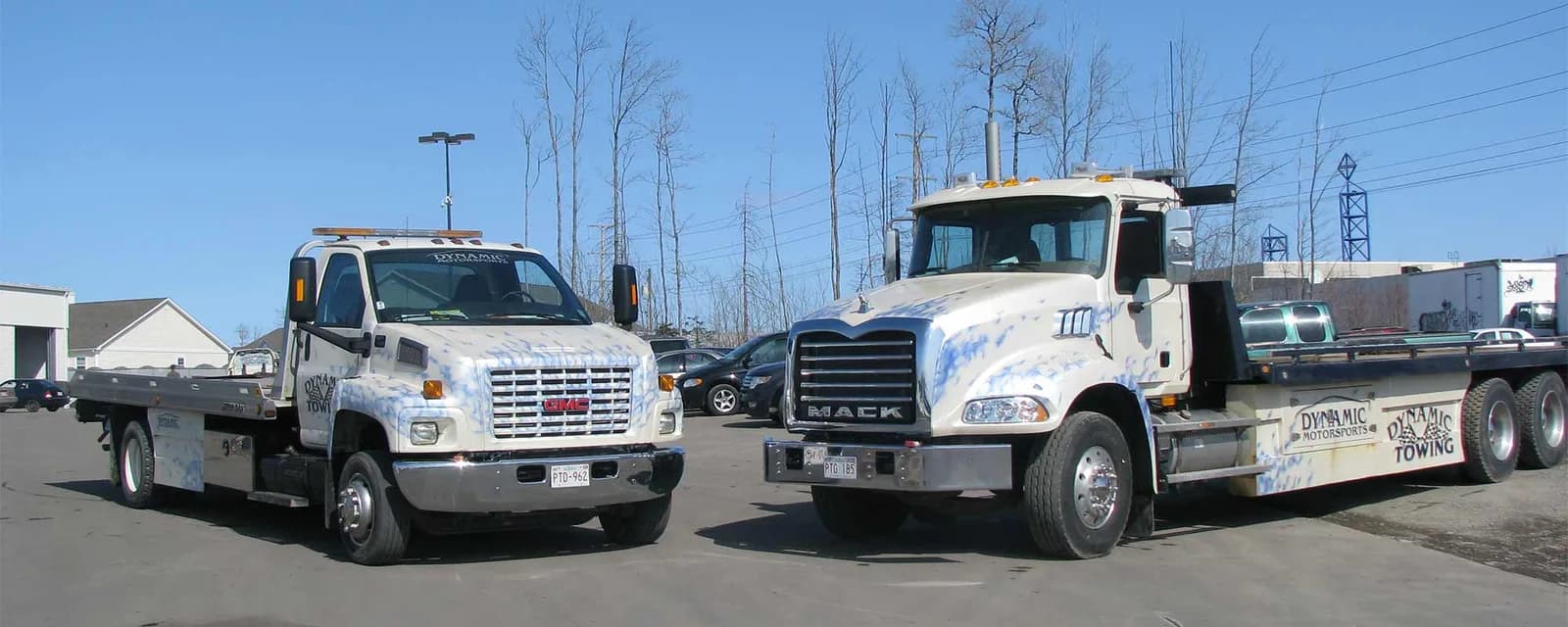
Dynamic Towing has run Moncton's roads since 1990 — 24 hours a day, every day, in English and French, backed by CAA, Canadian Tire, and a 4.5-star reputation across hundreds of reviews. Our fleet includes flat-deck carriers for exactly this situation — no wheel-lift guesswork, no drivetrain risk. Visit the towing service page to see the full fleet, or get in touch and tell us what you're driving.