
Labour Day has passed and the campgrounds are thinning out, but travel trailer season in New Brunswick isn't over — it's in its last good stretch. Cooler nights, quieter provincial parks, and the last runs to PEI and Nova Scotia before storage season starts. It's also when trailers that sat hitched and half-forgotten all summer start showing their weak points on the highway. Here's what to know before you tow one, and what to do if something lets go on the road.
Do you need a permit?
Most travel trailers and campers fall within New Brunswick's standard width and weight limits for towed vehicles, so they don't need a special permit to move on provincial highways. Where it changes is size: a fifth-wheel, park model, or wide-body unit that exceeds the standard width or weight thresholds needs an oversize or overweight permit from Service New Brunswick before it moves. If you're not sure whether your unit qualifies, check with Service New Brunswick directly rather than guessing — the rules are based on exact measurements, not the trailer class printed on the sticker.
Hitch weight and tow vehicle rating matter just as much as the legal limit. A trailer that's technically street-legal but overloaded for the tow vehicle behind it is where a lot of the trouble on this list starts.
Routes that need extra thought
New Brunswick's highway network handles trailer traffic well, but a few spots reward planning ahead:
- The Confederation Bridge. High-sided vehicles, including trailers and motorhomes, are subject to wind advisories and can be restricted or closed to crossing in high crosswinds. If you're timing a PEI run in a fall system, check the bridge's current wind status before you commit to the crossing.
- The Saint John–Digby ferry. For a Nova Scotia run, the Bay of Fundy crossing from Saint John can save real highway time for a larger rig versus driving the long way around. It runs seasonally, so confirm the schedule before you plan around it.
- The small cable ferries on the Saint John River — at Gagetown, Belleisle, and a few other crossings — are a scenic shortcut for a light vehicle, but a long trailer combination can exceed their length limits. Plan the bridge route instead if you're pulling anything sizeable.
- Trans-Canada rest stops. Route 2 has rest areas spaced through the province that suit a trailer rig for a break — worth noting on a longer run so you're not searching for a shoulder with enough room to pull off safely.
What goes wrong most often
The calls we get for campers and travel trailers cluster around a short list:
- Trailer tire failures. Trailer tires see less mileage than a car's but age out faster from UV exposure and sitting loaded in a driveway all summer. A blowout on the highway is the single most common trailer call we take.
- Hitch and coupler problems. A coupler that isn't latched and pinned, or safety chains left loose or unhooked, can let a trailer separate from the tow vehicle — rare, but serious when it happens.
- Electric brake controller faults. Travel trailers with electric brakes rely on a controller in the tow vehicle. A loose connector or a controller that's stopped talking to the trailer means the trailer brakes aren't doing their share, which shows up as a longer stopping distance or a sway you can feel.
- Sway from crosswinds or an unbalanced load. A trailer loaded tail-heavy, or caught broadside by wind on an open stretch like the bridge or a rural highway, can start to sway hard enough that the driver needs to pull off rather than fight it out.
What to do if it happens
If a trailer starts swaying, ease off the accelerator — don't brake hard — and let the rig settle before working toward the shoulder. If a tire blows or a coupler lets go, get as far onto the shoulder as you safely can, put your hazards on, and set out warning triangles if you have them.
Call with as much detail as you can give: your location (highway and nearest kilometre marker, or a dropped pin), what the trailer is and roughly how big, what happened, and whether the tow vehicle is still safely connected. That tells dispatch what's rolling — a flat tire change is a different call than a trailer that's detached in the ditch, and the right equipment depends on which one it is.
What it costs
There's no flat rate for a trailer call — a roadside tire change is priced differently than towing a disabled trailer off the highway, and we'll tell you the number before anything moves. If you carry CAA, Canadian Tire Auto Club, or an insurance roadside rider, check whether trailer towing is included in your plan — some policies cover the tow vehicle only. For the general breakdown of how towing is priced across NB, read our New Brunswick towing cost guide.
If your trip is taking you further than a local run — say, a fall haul-out from a PEI campground back to storage in Moncton — our long-distance towing guide covers how those runs are planned and priced.
Who you're calling
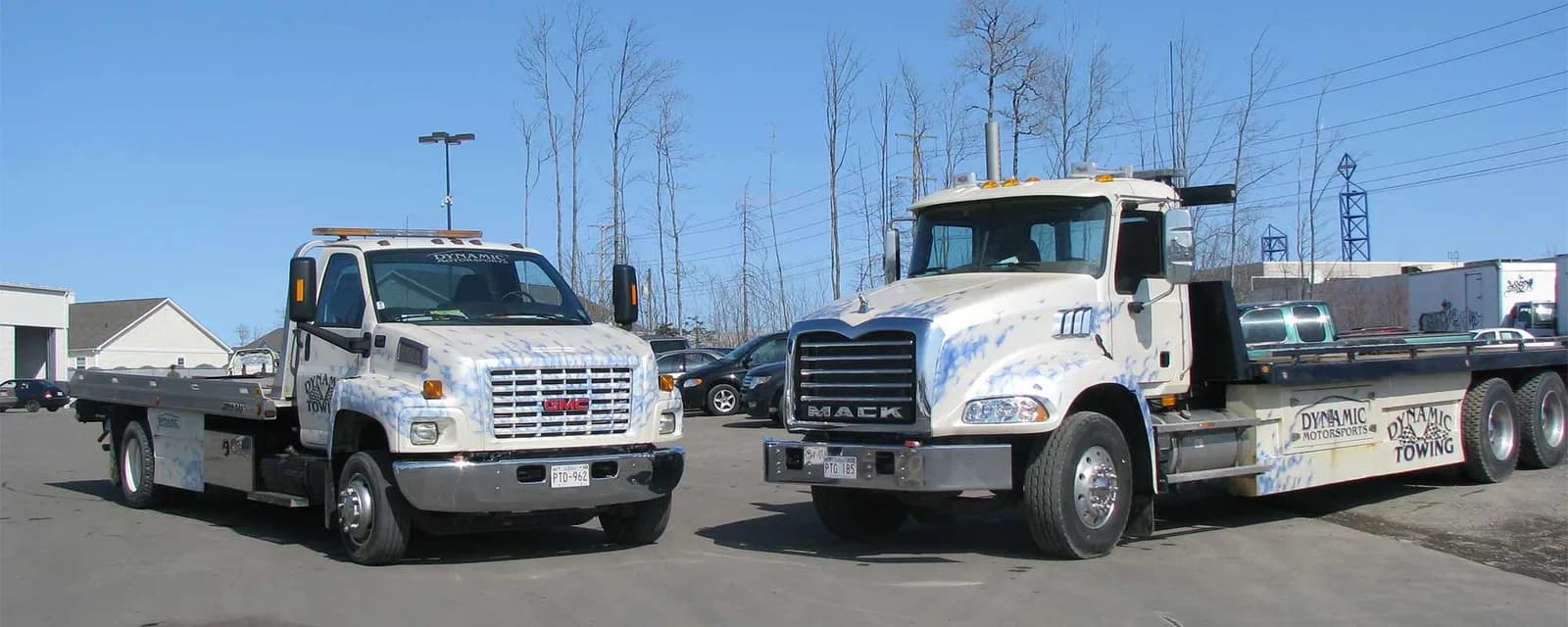
Dynamic Towing has run Moncton's roads since 1990 — 24 hours a day, every day, in English and French, backed by CAA, Canadian Tire, and a 4.5-star reputation across hundreds of reviews. Whether it's a flat on the shoulder of Route 2 or a trailer that needs to come off the road entirely, one call gets the right truck moving. Visit the towing service page for fleet details, or get in touch before your next run.