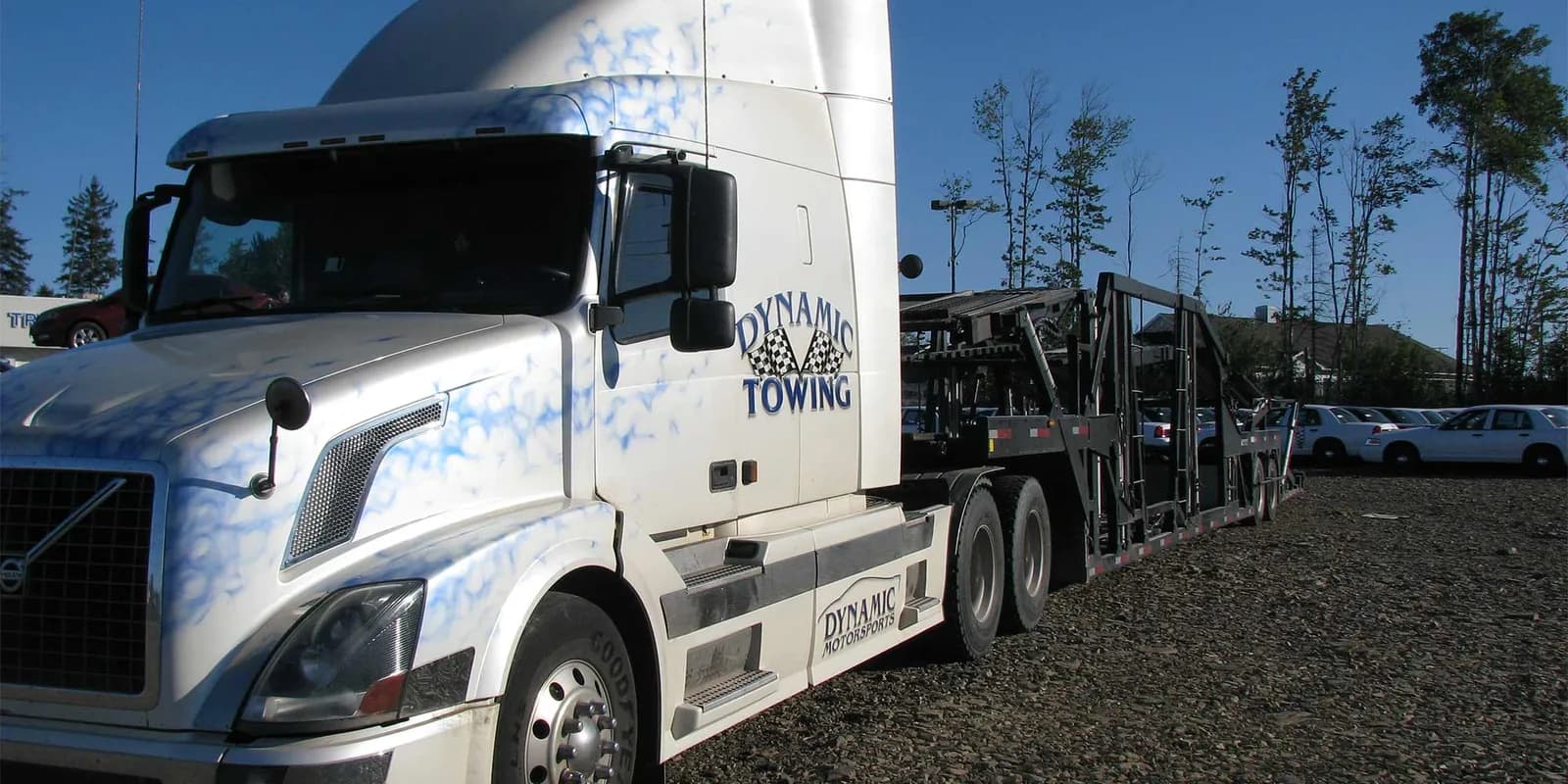
Most of the calls we take are for exactly what you'd picture: a car or pickup going onto a flat deck. But every week brings jobs that don't fit that picture — a skid-steer that has to change job sites, a seized all-wheel-drive wagon, a sports car too low to climb a ramp without leaving its bumper behind. For those, we bring the Landoll. If you've never heard the name, you're not alone: most people discover Landoll trailers the day they suddenly need one.
What a Landoll trailer actually is
A Landoll — the brand name that became the generic term, like Kleenex — is also called a tilt-deck or traveling-axle trailer. It's a heavy-duty trailer built around one trick: the bed tilts hydraulically while the rear axles slide back underneath it. Those two motions together bring the deck down to a very shallow angle, almost flush with the ground.
That sounds like a small detail. It's the whole point. A steep ramp angle is what scrapes bumpers, snags hydraulic lines, and grinds undercarriages on the way up. On a Landoll, equipment is driven or eased on nearly level — faster, gentler, and safe for loads that a conventional ramp would damage or simply couldn't take.
How it's different from a regular tow
Landoll towing doesn't replace the rest of the fleet — it fills a specific gap between them.
- A flat deck is the right call for most cars and anything with all-wheel drive, but the deck tilts as one piece, so the loading angle stays fairly steep and heavy machines are out of its league.
- A wheel-lift is quick for short moves of light, rolling vehicles — but it leaves two wheels on the pavement, which is exactly what you don't want for AWD drivetrains.
- Heavy recovery gear handles rollovers, jackknifed rigs, and vehicles in bad positions. Powerful, but specialized and priced accordingly.
- The Landoll owns the middle ground: loads that are too heavy, too low, or too fragile for a standard deck, but that don't need accident-recovery muscle — they just need a gentle, nearly-level ride up.
The jobs a Landoll is built for
- Construction equipment. Skid-steers, mini-excavators, and compact loaders are heavy, low to the ground, and often not running when they need to move between sites. The shallow angle loads them without stressing lines or undercarriage.
- Farm equipment. Tractors and implements moving between properties or to the dealership for service — especially when they won't start and need low-strain loading.
- Dealer and auction vehicles. Non-runners and low-clearance cars that can't risk one more scratch on the way to the lot.
- AWD and 4x4 vehicles. All four wheels ride off the pavement, which is the only safe way to move most modern drivetrains any real distance.
- Industrial moves. Machinery and awkward, heavy loads relocating between facilities — the kind of cargo a standard tow truck was never built to carry.
What it costs
Honestly: more than a standard tow, well under heavy-recovery rates. Like every job we run, it's priced on the load, the distance, and the loading conditions — a running skid-steer on level gravel is not a dead one in soft ground. Ask for the rate when you call; a good operator explains it before anything is loaded, not after.
Where we haul
We're based in Moncton, and the Landoll travels: all of New Brunswick, all of Prince Edward Island, and the Halifax–New Brunswick corridor on request. A dealer in Charlottetown, a contractor in Fredericton, equipment coming up from Halifax — it's the same phone number and the same trailer.
Who you're calling
Dynamic Towing has run Moncton's roads since 1990 — 24 hours a day, every day, in English and French, backed by CAA, Canadian Tire, and a 4.5-star reputation across hundreds of reviews. If you've got a machine, a dead AWD, or a low car that needs to move, get in touch and we'll bring the right deck.