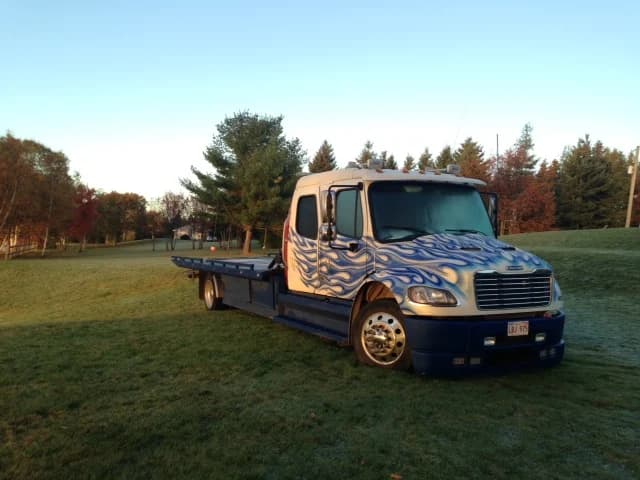
Prince Edward Island is an island. Every vehicle that moves on or off it — under its own power or on the back of a flat deck — crosses water to get there. For most of our PEI calls, that crossing is the Confederation Bridge. For a smaller number, usually tied to a Nova Scotia move, it's the Wood Islands ferry instead. The two crossings work differently, and which one applies changes the timing and the plan for your tow.
The Confederation Bridge: the route from New Brunswick
The bridge connects Cape Jourimain, NB, to Borden-Carleton, PEI — about 12.9 km, and it's the route for almost every tow between Moncton and the Island. It's open year-round, 24 hours a day; a flat deck or wrecker drives straight across like any other vehicle, no booking required. Tolls are collected only when leaving the Island, not entering, so a tow heading onto PEI pays nothing at the crossing itself.
The one thing that can slow a bridge crossing is wind. High crosswinds occasionally restrict high-profile vehicles — motorhomes, loaded car carriers, empty cube vans — and in rare, severe conditions close the bridge to all traffic. If your tow is weather-sensitive (a wide load, a tall RV, a trailer on top of a flat deck), ask dispatch to check the current bridge advisory before committing to a same-day crossing.
The Wood Islands ferry: the route from Nova Scotia
Northumberland Ferries runs between Wood Islands, PEI, and Caribou, NS — the crossing that matters if your vehicle is moving between the Island and Nova Scotia rather than New Brunswick. It's seasonal, typically running from spring into early winter, with a crossing of a little over an hour. Unlike the bridge, it isn't open around the clock: sailings run on a schedule, there's no reservation system, and a loaded flat deck boards on a first-come basis alongside everyone else's vehicle.
That schedule is the main thing that changes about a ferry-side tow. A bridge crossing fits into a same-day dispatch without much thought. A ferry crossing means the truck's arrival has to line up with a sailing — missing one by ten minutes can mean an hour's wait for the next, not a quick turnaround. If your vehicle needs to reach Nova Scotia (or come from it) via Wood Islands, tell dispatch that up front so the trip is timed around the ferry rather than around the truck.
What actually changes about the tow
Whichever crossing applies, the vehicle itself travels the same way it would on any long-distance move: a driveable car goes on a car carrier, a non-driveable one gets loaded stationary onto a flat deck, and an AWD or 4x4 that can't ride on its own axles needs the flat deck regardless — the same rule covered in our long-distance towing guide. What's different is the logistics layer sitting on top of the tow: a toll to budget for on the way out, or a sailing time to hit on the way across. Neither one changes the mechanics of the tow itself, just the timing around it.
For a boat on a trailer rather than a car, the same crossings apply, but beam width becomes the extra variable — see our boat towing guide for NB and PEI for when a wide-load permit comes into play.
Confirming coverage before you go
An interprovincial tow is still a long-distance tow for billing purposes, and most roadside coverage has a distance ceiling that a PEI or Nova Scotia crossing can bump up against:
- CAA membership covers towing to a per-incident distance limit that varies by tier — confirm the ceiling before assuming a Moncton-to-Charlottetown or Moncton-to-Nova Scotia run is fully covered.
- Canadian Tire Auto Club works the same way — call your provider and request Dynamic Towing by name before the truck is dispatched; we can't open the claim on your behalf.
- Insurance roadside endorsements often cap the covered distance well short of a cross-strait move. Check your policy rather than assuming it stretches that far.
None of these programs book the crossing for you — you open the claim, we handle the bridge or the ferry.
What it costs
A PEI tow is priced the same way any long-distance run is: by distance, vehicle type, and whether loading is straightforward or involves recovery first. The bridge toll (when applicable) and any ferry fare are line items on top of that, not hidden in a flat rate — we quote before anything is loaded, not after. For the full breakdown of how towing is priced across the province, read our New Brunswick towing cost guide.
Who you're calling
Dynamic Towing has run Moncton's roads since 1990 — 24 hours a day, every day, in English and French, backed by CAA, Canadian Tire, and a 4.5-star reputation across hundreds of reviews. We cover all of New Brunswick, all of Prince Edward Island, and the Halifax–NB corridor on request — bridge or ferry, it's the same dispatcher. Visit the towing service page for the full fleet, or get in touch and we'll plan the crossing before anything rolls.